


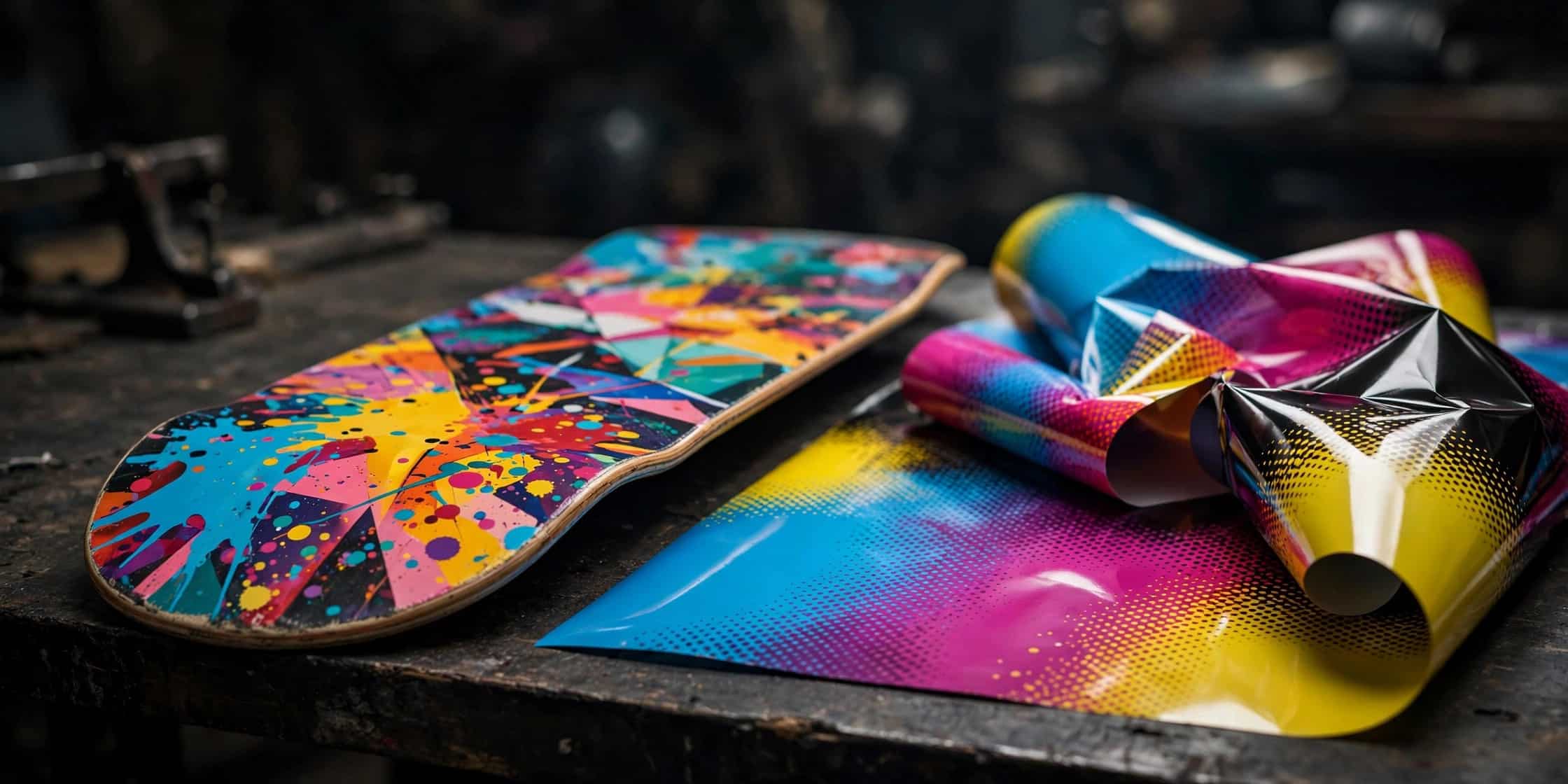
The best heat transfer for skateboards is real wear heat transfer. It bonds ink into the deck so the graphic wears gradually — like a pro deck — instead of cracking or peeling. Full-color artwork, no per-color setup fees, from 20 boards up. Here is the comparison.
What “Best” Depends On
Four things decide which method is right for your brand:
- Durability. Must survive grinds, tail scrapes, and abrasion.
- Detail. Can it reproduce full-color art, gradients, and fine lines?
- Run size. 20 boards for a limited drop, or 2,000 for a catalog line?
- Budget. Setup costs matter as much as per-unit cost.
Real Wear Heat Transfer: How It Works
Real wear heat transfer is a full-color process made for skateboard decks. Artwork is printed onto a transfer medium, positioned on the deck, and bonded with a heat press (around 200°C / 400°F). Once the carrier film is peeled away, the graphic sits in — not on — the surface.
Because the ink is fused to the deck rather than layered on top, the graphic wears like a pro deck graphic — scuffing and fading gradually instead of lifting at the edges, which is the behavior skaters expect.
No per-color setup charges means full-color art costs the same as simple one-color designs. Runs start at 20 sheets, so it works for limited drops, shop exclusives, and testing new graphics before scaling.
Screen Printing: Great for Huge Runs
Screen printing is the traditional method for mass-produced deck graphics:
- Pros: Lowest per-unit cost at very large volumes. Durable and widely understood.
- Cons: Every color needs its own screen, each with setup cost and prep time. Full-color artwork is expensive or impractical. Short runs are uneconomical — setup costs dominate at low quantities.
For thousands of boards with simple art, screen printing is hard to beat. For smaller brands running full-color art, setup cost is usually the dealbreaker.
Stickers and Vinyl: Cheap but Not Skateable
Vinyl stickers are the easiest option — no press, no heat, no setup. But they sit on top of the deck and peel: the first slide lifts the edges, moisture gets underneath, and within weeks the board looks cheap. Fine for slaps and hangtags — not for a board you want skaters to ride.
Head-to-Head Comparison
| | Real wear heat transfer | Screen printing | Stickers / vinyl |
|—|—|—|—|
| Durability when skated | Wears gradually like a pro deck | Durable at high volumes | Peels quickly |
| Full-color detail | Yes, no per-color setup | Costly per color | Yes, but not skateable |
| Small runs (20–200 boards) | Practical, MOQ 20 sheets | Usually uneconomical | Easy but low quality |
| Large runs (1,000+ boards) | Works, scales down in price | Lowest per-unit cost | Not suitable |
| Brand perception | Authentic, pro-level | Professional | Looks cheap |
Heat transfer fits the widest range of brand needs — screen printing only wins at very high volumes with simple artwork.
Verdict: Real Wear Heat Transfer Wins for Most Brands
For brands that want authentic, skateable graphics without screen-printing setup costs, real wear heat transfer is the best choice. Full-color pro-level graphics, wear like a real deck, from 20 boards up.
On cost: BRUH Manufacturing prices a standard 9″x33″ gloss sheet at $3.80, dropping to around $1.75 per sheet in bulk — MOQ 20 sheets, 5–7 day turnaround, 48-hour rush available.
See exact numbers in the custom skateboard heat transfer pricing guide, read the complete guide to custom skateboard heat transfers, and learn how to heat press a skateboard deck.
FAQ
What is the best heat transfer for skateboards?
Real wear heat transfer. It fuses ink into the deck with a heat press, so the graphic wears gradually like a pro board instead of peeling like vinyl — no per-color setup fees, runs from 20 sheets.
How much does real wear heat transfer cost per skateboard?
At BRUH Manufacturing, a standard 9″x33″ gloss sheet starts at $3.80 and drops to around $1.75 per sheet in bulk. Full details are in the pricing guide.
What equipment do I need?
A heat press reaching around 200°C (400°F) with even pressure across the deck. See the step-by-step heat press guide.
What artwork should I submit?
300dpi PNG or PDF at actual size — 9″x33″ plus 0.25″ bleed for a standard deck.
Ready to print? Request a quote from BRUH Manufacturing — factory-direct real wear heat transfers from Fuzhou, China, shipped worldwide, with 5–7 day standard turnaround and 48-hour rush available.