

Support
Frequently asked questions
Any questions
You’ve got the idea, we’ve got you covered.
Skateboard heat transfer paper is a specialized material, typically a PET carrier film, that allows designers to transfer high-quality graphics onto a deck. Unlike a sticker or vinyl wrap, the heat transfer process uses heat and pressure to create a chemical bond between the ink and the wood or lacquer of the deck.
The process generally involves these steps:
- Printing: The design is printed in reverse onto the transfer film using specialized inks.
- Application: The transfer sheet is aligned on the deck and run through a heated silicone roller machine.
- Bonding: At temperatures around 200°C (400°F), the heat and pressure release the ink from the carrier, allowing it to penetrate the wood’s structure.
- Peeling: Once cured or cooled, the plastic carrier sheet is peeled back, leaving the ink bonded to the deck.
- Screen-Printed Transfers: These are the industry standard for large production runs (minimums typically around 50–100 sheets). They use hand-mixed Pantone spot colors, which are more vibrant and accurate than digital dots. While they require setup fees for screens, they offer the best unit cost for high volumes.
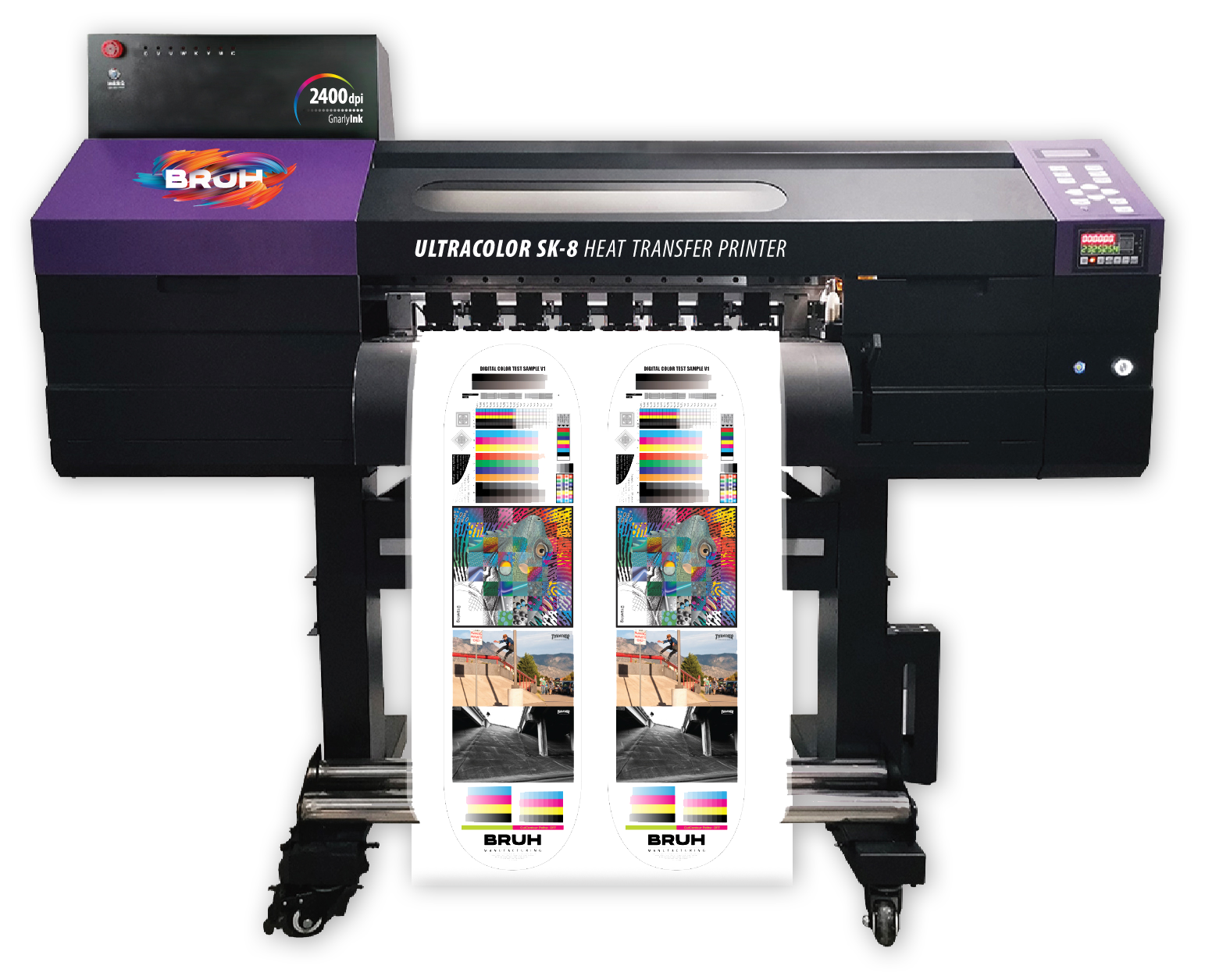
- Digital Transfers: These achieve the highest level of detail, making them ideal for photographic images and complex shading. They have no setup fees, making them perfect for small runs or one-off samples, though the cost per individual transfer is higher.
- Resolution: Files must be set to 300 DPI to ensure sharpness.
- Dimensions: Standard skateboard graphics should be 9 x 33 inches, while longboards are typically 11 x 42 inches.
- Bleed: You must include a 0.25-inch bleed on all sides to prevent white edges after trimming.
- Safety Zone: Keep all important logos and text within the inner safety lines and away from the truck hole areas to ensure they aren’t cut off or obscured by hardware.
There are two primary methods for integrating the natural wood grain:
- Transparent Printing: This is achieved by omitting the white ink underlay. Lighter colors will blend with the grain, while white areas in the design will be 100% transparent, showing only the wood.
- Knockout Printing: This involves using a white underlay for the colored parts of the design but leaving specific “knockout” areas with no white or ink, allowing the raw wood to show through in specific patterns.
Yes. When properly applied using industrial-grade machines, the inks form a permanent bond with the deck that is resistant to the wear and tear of skateboarding. However, some sources note that screen-printed transfers can be slightly more durable than digital ones because the ink sits slightly differently on the surface.
- Screen-printed transfers can be stored at room temperature for at least one year if protected from air, humidity, and direct sunlight.
- Digital transfers have a slightly longer shelf life and can be stored at room temperature for at least one year if protected from air, humidity, and direct sunlight.
Why choose Bruh Manufacturing over 2Hex for your heat transfer production?
We have fully control on our own printing facilty. The turnaround time is much shorter than 2Hex as they order from Chinese suppliers like us.